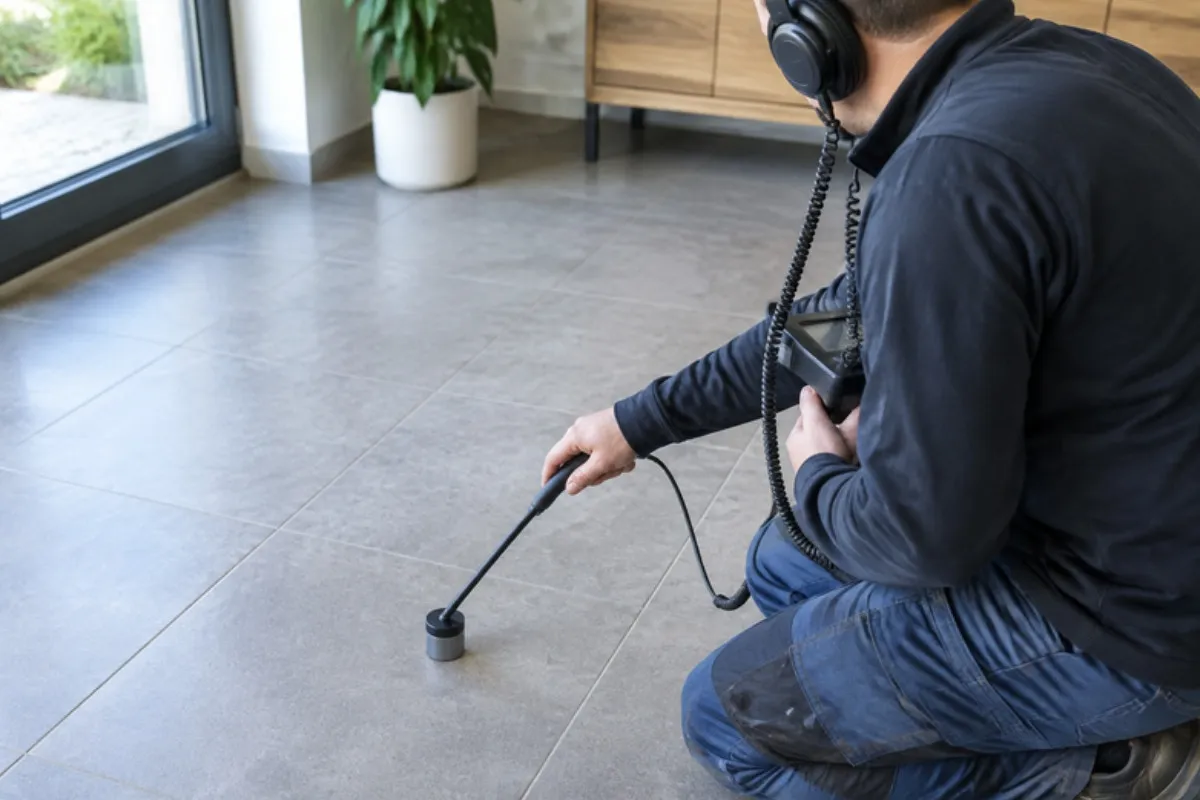
In Waldorf, a hidden leak usually shows up as a Charles County water bill that climbs without explanation, a meter that keeps registering with every tap closed, or a damp patch on drywall or flooring. A plumber can test the piping in sections and narrow down the source before opening anything. Call the number on this page to be connected with a local plumber in Waldorf.
How can I tell whether my Waldorf house is losing water?
Start at the meter. Turn off every faucet, the ice maker, the washing machine and any lawn irrigation, write down the reading, and look again an hour or two later without using water. If the number moved, water is escaping somewhere. Then add a few drops of food coloring to each toilet tank; color reaching the bowl within fifteen minutes points to a worn flapper. Beyond those two checks, watch for stains under sinks, a musty closet that backs onto a bathroom, or a strip of lawn that stays soft in dry weather above the pipe coming in from the street.
Who do I call if the leak looks like it's on the county's side?
Waldorf is not on WSSC Water. Its public water comes from the Charles County Department of Public Works, drawn mostly from deep county wells in the Patapsco and Magothy aquifers and blended with water the county buys from WSSC. If water is pooling at the meter pit, along the curb or in the street, call the county's Utilities Division at 301-609-7400 so its crews can check the public side. Water surfacing between the meter and your foundation, or anything inside the house, is work for a plumber.
Could my lawn irrigation be the culprit?
In newer neighborhoods it often is. Charles County requires lawn irrigation systems to have a reduced pressure zone backflow assembly, tested at least once a year by a certified master or journey plumber, and the system may not be used until that assembly passes. A relief valve that keeps discharging, a cracked zone valve or a nicked lateral under the grass can move a surprising amount of water without anyone noticing. Close the irrigation system's own shutoff and recheck the meter to rule it in or out.
A note on Waldorf homes
Most houses in the 20603 ZIP code were built from 1980 onward, with the biggest share going up between 1980 and 1999. That usually means copper or plastic supply pipe rather than galvanized steel, but it also means a generation of water heater connections, washer hoses, shutoff valves and faucet cartridges that has reached the age when parts start to weep. When you call, mention whether the basement is finished, where the main shutoff is and what the meter did during your test. If the fix turns into more than a fixture repair, permits in Waldorf come from Charles County Codes, Permits and Inspection Services in La Plata, not from WSSC Water.
Leak Detection questions in Waldorf
How do I use my water meter to check for a hidden leak?
Water is bubbling up near the curb or meter. Who do I call?
Could the leak be in my irrigation system or an outdoor faucet?
Can a fairly new house still have a hidden leak?
More plumbing services in Waldorf
Leak Detection nearby
Sources
- Waldorf water system consumer confidence report (Charles County DPW, via Maryland Department of the Environment)
- Charles County DPW-Utilities: Cross-Connection Control Program
- Maryland State Board of Plumbing: local plumbing jurisdictions
- ZIP 20603 housing by year built (city-data.com)
- Waldorf, Maryland (Wikipedia)
Last updated: